

What is FLARE?

The Center for Academic Esports will be the first of its kind in the world, focusing on the connection between technology, gaming, esports, and transferable skills as well as creative arts. This center has the potential to play a crucial role in shaping the future of education and influencing the future job market. It will also be closely aligned with the University of Agder’s (UiA) strategy towards 2030. Esports, thereby, acts as a future lab for the digital society, and academic esports can be utilized to make the knowledge applicable towards future problems that society is facing. The development of our own esports programs, which bring together multiple faculties to co-create, lays the foundation for this center to extend the same approach beyond our borders, transforming it into a powerhouse for all activities related to this new and exciting field.
Organizational Structure
The center will be closely connected to industry and external actors through active participation in project activities and involvement in the center’s governing bodies. The existing Academic Esports Seminar will be institutionalized on a yearly basis to act as a hub conference. The center will actively collaborate with other research environments to enhance and promote the research conducted and build on the knowledge developed.
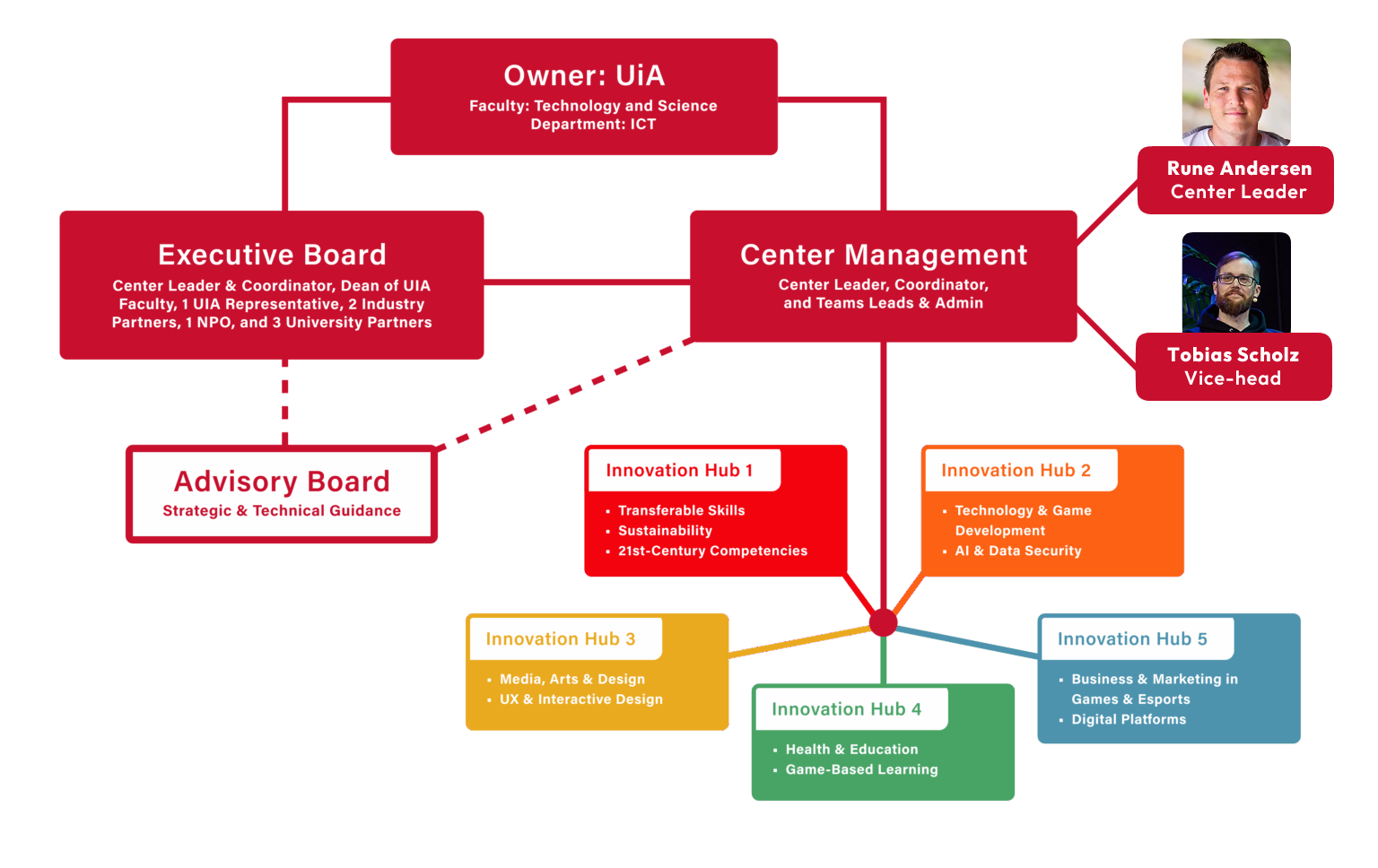
The Executive Board’s role is to approve the center’s strategic direction. The center will have shared leadership, consisting of a leader and a coordinator. The leader of the Executive Board will be the Dean or Pro-Dean of Research from the host faculty. The board will also include 2 representatives from UiA, 2 from the industry (one being from the developer’s side), 2 from research centers, and 2 from partner universities.
The center will be managed by a unit called “Center Management,” consisting of the center leader (from the host faculty), the coordinator, and a dedicated administration team responsible for the daily operations of the center. This group will also facilitate connections and coordinate relationships between all involved parties. The center leaders will meet digitally to ensure the center’s focus on sustainability.
Given the scale of the gaming and esports industry, it is essential to draw input from global experts. The potential within academic esports and gaming technology is vast, and we have only just begun to scratch the surface. International collaboration is key to unlocking this potential. The center aims to be a key contributor in identifying the potential of academic esports and transferable skills, working closely with international environments in the EU and other global regions. The center will attract the best international researchers and professionals, with efforts already underway.
Learn about who’s in FLARE’s advisory board here.
Meet Center Management

Rune Andersen
Center Leader for FLARE (Future Lab for Research in Academic Esports), Associate Professor at University of Agder (UiA), study program leader Academic Esports, and Assistant head of departement (ICT). Developed the first complete bachelor’s program in Academic Esports in Europe, still currently running. In addition, created and developed courses designed for different groups of people to understand the power of transferable skills from games over to the industry or society as a whole.

Tobias Scholz
Vice-Head for FLARE (Future Lab for Research in Academic Esports), Associate Professor at the University of Agder, and a pioneer in esports research with 25 years of experience. Founder of the Esports Research Network and scientific director of metagame, Scholz bridges the gap between academia and business. In Norway, he focuses on developing innovative study programs that use esports to teach skills to the workforce of the future.
The Innovation Hubs
Academic Esports encompasses a broad field of study. To address different aspects of esports, gaming technology, and academia, the center will have five teams, each focusing on a specific area. These teams will have overlapping fields of interest, and their leaders will be part of the leadership group.
Innovation Hub 1

Photo by cottonbro studio from Pexels
Innovation hub 1 focuses on transferable skills, sustainability and 21st century competencies. Transferable skills refer to how digital games can help identify, train, and further develop skills. This hub also addresses the sustainability of such a vast industry and how we can collectively reduce the negative environmental impact of the digital gaming and esports sectors. Lastly, 21st century competencies refer to critical thinking skills, cooperation and communication, and understanding the legislation regarding data governance and ethical considerations.
Innovation Hub 2

Photo by Pavel Danilyuk from Pexels
Innovation hub 2 focuses on technology & game development, AI, and data security. This includes the process of creating games from start to finish (from the game design to programming) the utilization of AI tools in the workspace, and our security within digital platforms. We often expose ourselves to many known and unknown factors online, and so, it becomes increasingly more important to understand the challenges connected to security and the proper maintainment of collected data.
Innovation Hub 3

Photo by Christina Morillo from Pexels
Innovation hub 3 focuses on media, arts, UX & interactive design. Media in general is very important and vital part of today’s online ecosystem, same applying to arts. UX design refers to user experience design, the process of designing platforms and solutions that are easy, enjoyable, and useful for the user to engage with. Similarly, interactive design tackles creating user-friendly experiences by focusing on the back and forth dialogue between the the user and the product.
Innovation Hub 4

Photo by Yan Krukau from Pexels
Innovation hub 4 focuses on health & education, and game-based learning. This means specifically the mental and physical health aspects of gaming and esports, and how steps can be taken to improve both for the athletes of today and tomorrow. As for game-based learning, it involves using games as the primary tool in instruction, where the learning outcomes of a class are achieved through some sort of gameplay.
Innovation Hub 5

Photo by Artem Podrez from Pexels
Innovation hub 5 focuses on business & marketing in games, and esports digital platforms. This means attention directed to the development of gaming and esports as an industry, creating sustainable models for economic and social operations, and researching the platformization of the industry. This team will also work on identifying and developing transferable skills to build talent.